|
Welcome to the vedphoto blog! Here you can keep up-to-date on research (Fluid Lensing), exhibitions (Physics In Vogue and Reactive Reefs) and photo-shoots. Learn about the techniques and stories behind my images by searching for a location or keyword. That picture of fruit bats from Northern Madagascar - I had to wade waist-high in bat guano to get it! Always a humbling experience. Physics In Vogue - Discoverer of WorldsSeptember 12, 2012: I am happy to announce that after imaging the Venus transit and Cygnus constellation with HiMARC technology and Dr. Natalie Batalha and the Kepler Spacecraft model in the studio, the first exhibition piece for Physics In Vogue, Discoverer of Worlds, is ready! The image below features NASA's Kepler Space Telescope Mission and its method for discovering extra-solar planets by photometric transit detection.
Discoverer of Worlds - Featuring original HiMARC imagery, Dr. Natalie Batalha and NASA's Kepler Mission
Final assembly, color, contrast and brightness adjustments made in Photoshop, nothing else. 48'' x 120'' framed canvas print (available in multiple formats). Here are some shots from the production:
Annular Solar Eclipse - Time-Lapse Panorama
What’s so special about an annular solar eclipse? Unlike a total eclipse—where the Sun is eventually blocked out entirely by the moon—with an annular eclipse the moon appears slightly smaller and never fully covers the Sun, even when the two are completely aligned. Such an event usually occurs with striking visual effect: in the moment of perfect alignment the Sun looks like a glowing golden ring with a hollowed-out core.
Ved and the HiMARC crew travelled to a park in Northern California in order to be along the path of the annular eclipse
On May 20th, 2012, Ved and the HiMARC team set out for Lassen Peak in Northern California where they knew the path of the eclipse would run. By setting up their telescopic equipment on this location they could assure that their images of the event would turn out like few others’—only along this path would the solar ring surrounding the moon appear with equal thickness. To capture the perfect image, Ved used a hydrogen-alpha bandpass filter, through which the details of the swirling hydrogen surface of the Sun is most visible. And for each phase of the eclipse, nine different shots were made with varying levels of exposure. By doing this, he could then digitally process the nine photographs, ultimately creating a single high dynamic range composite image. You can see photographs from the HiMARC team's trip to Mt. Lassen below, as well as additional high dynamic range images of the eclipse.
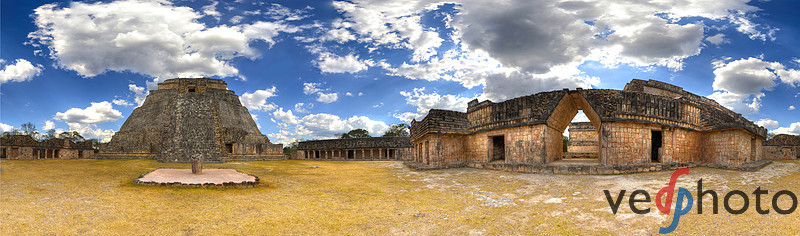
Uxmal, Magician's Pyramid
The ruins of the ancient Mayan city, Uxmal, go from impressive to unbelievable when you consider that these large stone structures were constructed without the use of wheels. It makes the myth surrounding the Pyramid of the Magician—that the structure was conjured by a dwarf over a single night—seem almost comparably plausible. Today the ancient city is well preserved, though photography has been greatly limited by the Mexican government. Capturing this panoramic, high dynamic range shot of the ruins was a very unique opportunity, and no other known photograph of such resolution and quality now exists. The photograph represents a stitched composite of over 5000 shots projected on an equirectangular plane, allowing you to not only appreciate the full 360° experience, but also enjoy the many fine details of the carved stone. To see more about the making of this image, click here.
Mayan Pyramid of Oxkintok
What does the world look like from the top of the ancient Mayan pyramid of Oxkintok? Well, something like this. Thousands of images were captured and stitched together to create this stereographic projection of the full view from up top.
In the past few years, more and more ruins like Oxkintok have been discovered after centuries of being covered by thick jungle foliage. Assisted by high resolution satellite imaging, archeologists have been able to pinpoint locations where vegetation has grown up over limestone due to its slightly different coloring only discernable through multi-spectral imaging. To see more about the making of this image, click here.
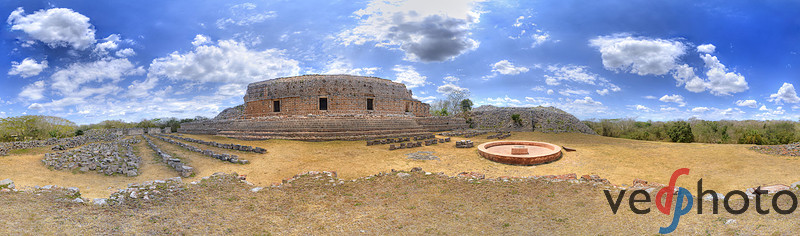
Mayan Ruins of Kabah, Mexico
18 kilometers south of the more famous Uxmal, via an anciently constructed pedestrian causeway, are the ruins of Kabah. The buildings here can be easily identified as distinct among Mayan architecture for the repetition of a single pattern along the façade. These tiles of carved stone have been extremely well preserved for over 1000 years and are well documented in this high-resolution panoramic image of one of the city’s buildings.
Restrictions on photographing Mayan ruins by the Mexican government have made large panoramas such as this very rare. This image is an HDR composite of over 5000 individual shots projected onto a equirectangular plane. To see more about the making of this image, click here. |