|
Welcome to the vedphoto blog! Here you can keep up-to-date on research (Fluid Lensing), exhibitions (Physics In Vogue and Reactive Reefs) and photo-shoots. Learn about the techniques and stories behind my images by searching for a location or keyword. That picture of fruit bats from Northern Madagascar - I had to wade waist-high in bat guano to get it! Always a humbling experience. New Samoa Coral Mapping results with Fluid LensingApril 2, 2014 - Updated fluid lensing results from the Reactive Reefs project in American Samoa. These are the first data sets processed on the new computer setup (funded by you!) and Agisoft's generous donation of their professional GIS software. Hover over figures to see descriptions below:
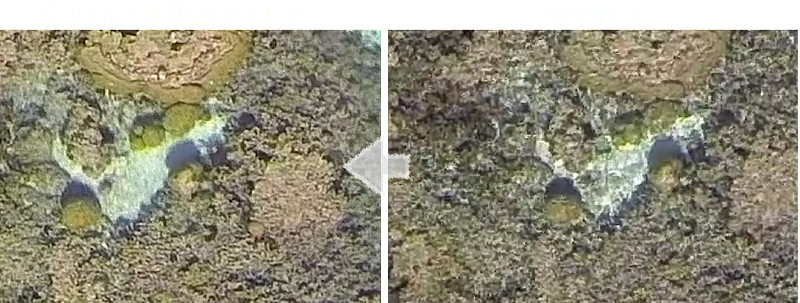
3D Coral Reef ReconstructionUsing structure from motion combined with Fluid Lensing (preliminary 1/10th resolution dataset) Updated 3D Mapping Results - Reactive ReefsNovember 2, 2013 - I am in the midst of my PhD qualifying exams, so bear with me until I am done on the 12th of November and can get back to processing all the coral mapping data from our trip to Ofu! Update (December 13, 2013) - I passed! Officially a PhD candidate. Some new results added below. I am in sore need of new equipment to process all the 3D data - check out the new Vedphoto store and holiday sale if you can. All proceeds go to funding the Reactive Reefs project and providing this data free to the public! However, as part of my research presentation, I did manage to make the first 3D map of the underwater reef from just a snippet of the full data set. After many grueling computer hours and over 9 hours of processing on an 8-core machine + GPU I have at last a preliminary 3D map! The reconstruction actually worked much better than I had imagined, though to finish the entire map I will surely need much better computational resources. The maps below have over 3.5 million polygons! Need to bump that up to ~100 million for the maximum resolution. The basic idea behind the 3D reconstruction is to use otherwise discarded data from the Fluid Lensing process and exploit the motion of the quad-copter over the reef. Fluid Lensing removes all the surface distortions from image sets, so I can accurately triangulate the distance to each voxel (three-dimensional pixel). Once I have a point cloud of data points, the computationally intensive process of fitting a surface to those points begins. Once the surface texture is computed and discretized into millions of small polygons, I can overlay the high-resolution texture that Fluid Lensing provides. Below is a schematic of how the imaging was captured. As the quadcopter moves about the surface, it creates a stereographic baseline to view the same surface from multiple points (like your eyes). This allows a distance to be computed and a 3D surface to be rendered.
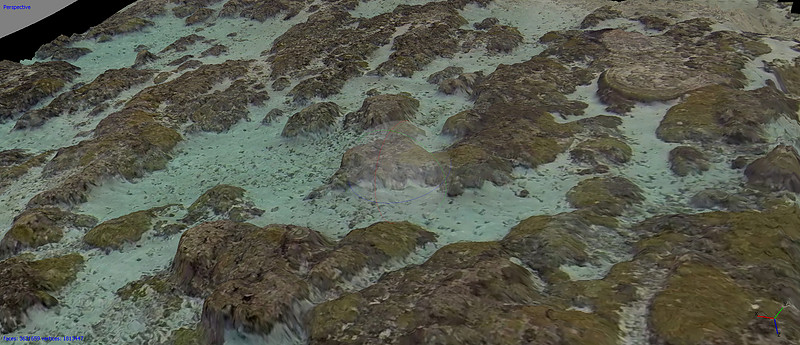
Here is a close up of the rendered 3D surface showing the 3D geometry of the corals beneath the ocean surface!
Here is the 3D modeled covered with the high-resolution Fluid Lensed map:
And a brief animation exploring the 3D environment. Sorry about the lag - I will need to get the funds together to build a dedicated 3D map-processing desktop that can handle the graphics and reduce the render time.
Preliminary Coral Reef 3D map More to come soon! Vedphoto Holiday Sale + New Store LaunchHead on over to the new vedphoto store where you can purchase items from past exhibitions to help support future public exhibitions, student internships and scientific research! Any support is much appreciated in helping me raise funds for new equipment to process all of the 3D Reactive Reefs coral data and trip expenses.
Holiday Sale - 50% has been taken off storewide and free shipping on all orders now until January 15, 2014!
Complete your order by 18 December for delivery by 25 Dec (continental USA guarantee). Orders placed after the 18th will be fulfilled by Jan 12. Store prices already reflect 50% discount. All items listed are in-stock and ready to ship.
Thank you for supporting my mission and I hope you enjoy your hand-made piece!
Reactive Reefs & Coral Mapping featured in Stanford NewsThe Reactive Reefs coral mapping using Fluid Lensing was featured on the front page of Stanford News and the Stanford Woods Institute for the Environment. Check out the links below to read the article by Rob Jordan. Thanks for your support and interest everyone! I am looking forward to processing all the data and images and readying Reactive Reefs for exhibit next year! DATAVIZ ART + TECH Exhibition October 3 @ San Francisco GeekdomCelebrate DATAVIZ Art +Tech @ Geekdom this Thursday, October 3, in San Francisco! Learn about the Fluid Lensing technology I developed to image through water and turbulent media at high-resolution and the massive amount of data that are crunched to produce my images.
I will have five large-format pieces on display featuring my latest work on brushed aluminum. Come on out, have a drink and support the Arts in Tech through these nonprofits! Info and event tickets available here:
|